What makes agentic systems different from standard AI integrations
Standard AI integrations are stateless and transactional — a prompt goes in, a completion comes out, and the application routes the result. Agentic systems are fundamentally different: the model is the orchestrator, deciding what actions to take, when to call external tools, and when the task is complete. This inversion of control — from the application directing the model to the model directing the application — introduces a new class of production concerns that have no equivalent in traditional software systems.
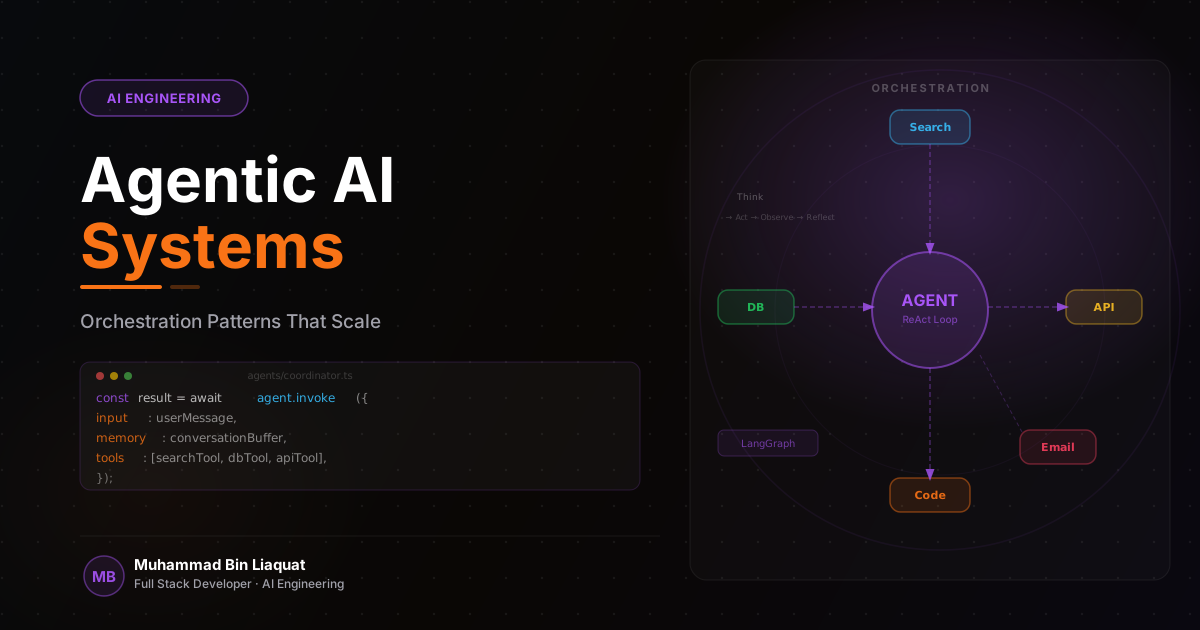
The defining characteristic of an agent is the ability to take multi-step actions in pursuit of a goal. A user request doesn't produce a single response; it initiates a loop where the model reasons about the current state, selects a tool or action, observes the result, updates its understanding, and decides whether to continue or conclude. This loop can span dozens of steps and multiple tool calls — each step introducing potential failure modes that the system must handle gracefully.
The production failure modes of agentic systems are different from those of standard applications. An agent can get into an infinite loop if the task completion condition is ambiguous. It can hallucinate tool parameters that fail silently at runtime. It can consume significant API costs on a task that could have been handled more efficiently. It can take destructive actions with real-world consequences if tool permissions are not carefully scoped. Each of these failure modes requires explicit architectural consideration.
The decision to build an agentic system versus a more constrained pipeline should be deliberate. Agents are the right choice when the task requires dynamic decision-making that cannot be predetermined — when the sequence of steps depends on intermediate results. When the task structure is known in advance, a deterministic workflow pipeline is more predictable, cheaper, and easier to debug. Reach for agents when flexibility is genuinely required, not by default.
- Define the agent's goal space precisely — agents with vague objective definitions tend to hallucinate task completion.
- Scope tool permissions to the minimum necessary for the task — agents should not have access to capabilities they don't need.
- Design the agent loop with an explicit maximum step count to prevent runaway execution.
- Distinguish between agentic tasks (dynamic decision-making) and pipeline tasks (known step sequence).
- Test agent behavior with adversarial inputs from the start — agents fail in unexpected ways that standard testing misses.
Agent loop architecture: planning, tool selection, and execution
The agent loop is the core execution pattern of any agentic system. In LangChain, this is the ReAct (Reasoning + Acting) pattern: the model generates a thought about what to do next, selects a tool and its parameters, observes the tool's output, and repeats until it determines the task is complete. Understanding the mechanics of this loop at a code level — not just conceptually — is essential for building systems that behave predictably in production.
LangChain's Agent and AgentExecutor classes implement the ReAct loop with configurable stop conditions and maximum iteration limits. The agent receives a list of available tools with their descriptions and schemas, and the model selects tools based on the task requirements. The tool descriptions are the most important prompt engineering surface in an agentic system — vague or inconsistent descriptions lead to incorrect tool selection even when the model understands the task correctly.
The planning step — where the model decides what to do next — is where prompt engineering has the most impact on agent quality. System prompts for agents should explicitly instruct the model on how to approach tasks: what to do when a tool returns an error, how to handle ambiguous instructions, when to ask for clarification versus making a best-effort attempt, and how to recognize when the task is complete. These instructions are as important as the task itself.
For complex tasks that require multiple distinct sub-goals, a hierarchical agent structure — where an orchestrator agent delegates to specialized sub-agents — often produces better results than a single agent trying to handle everything. The orchestrator handles planning and sequencing; the sub-agents handle specific domains (data retrieval, code execution, external API calls). This separation of concerns makes each agent's prompt and tool set simpler, which improves reliability and makes debugging tractable.
- Set a `max_iterations` limit on all agent executors — prevent infinite loops with an explicit hard stop.
- Write tool descriptions as if explaining to a skilled human who has never seen the tool — precision matters.
- Include explicit instructions in the system prompt for error handling, ambiguity, and task completion recognition.
- Use verbose mode during development to observe the agent's full reasoning chain — essential for debugging.
- Consider hierarchical agents for complex tasks: an orchestrator with specialized sub-agents is more reliable than one agent doing everything.
Tool design and schema engineering for reliable tool use
Tools are the actions an agent can take — searching a knowledge base, querying a database, calling an external API, generating a report, or sending a notification. The quality of an agentic system is almost entirely determined by the quality of its tools: how clearly their purpose is described, how predictably they behave, and how gracefully they handle errors. A perfectly prompted agent with poorly designed tools will consistently underperform a mediocrely prompted agent with excellent tools.
Every tool requires three things: a name that is unambiguous and action-oriented (search_knowledge_base, not get_data), a description that explains when to use the tool and what it returns (not just what it does), and a JSON schema that precisely defines input parameters with validation constraints. The schema is what the model uses to construct tool calls — ambiguous or permissive schemas produce invalid inputs that cause runtime failures or unexpected behavior.
Tool implementations should be idempotent and side-effect-free when possible. An agent may call a tool multiple times if it doesn't receive the expected response or decides to retry with different parameters. Read-only tools (search, retrieve, calculate) are safe to call multiple times. Write tools (create, update, delete, send) should be designed with idempotency keys to prevent duplicate actions when the agent retries. Logging every tool invocation with its parameters and result is essential for debugging agent behavior in production.
Error handling in tools deserves special attention because errors become part of the agent's information environment. When a tool fails, the error message becomes input to the model's next reasoning step. Descriptive error messages that explain why the tool failed and what the agent could try instead produce better recovery behavior than generic error strings. For tools that interact with external APIs, include the HTTP status code and any error details from the upstream service in the returned error message.
- Name tools with action verbs that clearly communicate their purpose: `search_knowledge_base`, `create_task`.
- Write tool descriptions from the agent's perspective: 'Use this tool when you need to...'
- Define strict JSON schemas with validation constraints — reject invalid inputs with descriptive error messages.
- Make all read tools idempotent; add idempotency keys to write tools to prevent duplicate side effects.
- Return structured error messages that help the agent reason about what to try next — not just 'error occurred'.
Memory architectures for stateful agent behavior
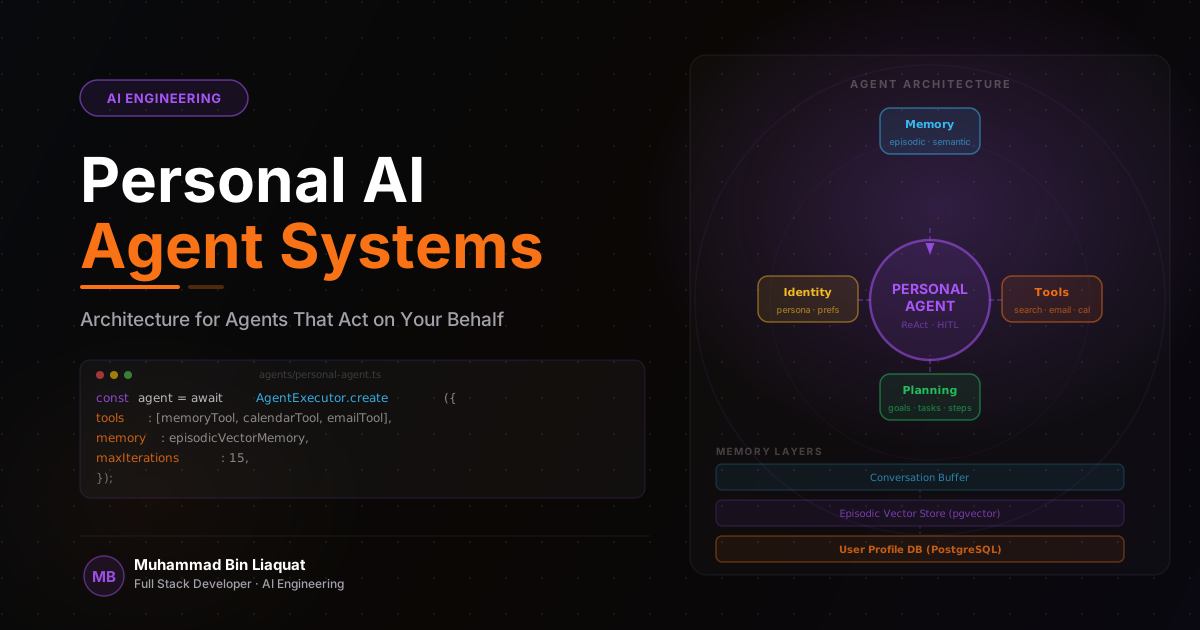
Agents that don't remember previous interactions produce inconsistent, repetitive behavior that users find frustrating. The concept of memory in agentic systems encompasses several distinct concerns: short-term context within a single conversation, working memory during task execution, long-term storage of facts about the user or domain, and episodic memory of past interactions. Each type requires a different storage mechanism and retrieval strategy.
Short-term memory is the conversation history managed by the LLM context window. For single-session tasks, this is typically sufficient — the model sees the full exchange and maintains coherence naturally. The constraint is the context window size: long-running conversations or tasks with extensive tool outputs can exceed the model's context limit. Strategies for managing context include summarization (compressing earlier turns into a summary), sliding window (keeping only the N most recent turns), and selective memory (storing only turns that contain task-relevant information).
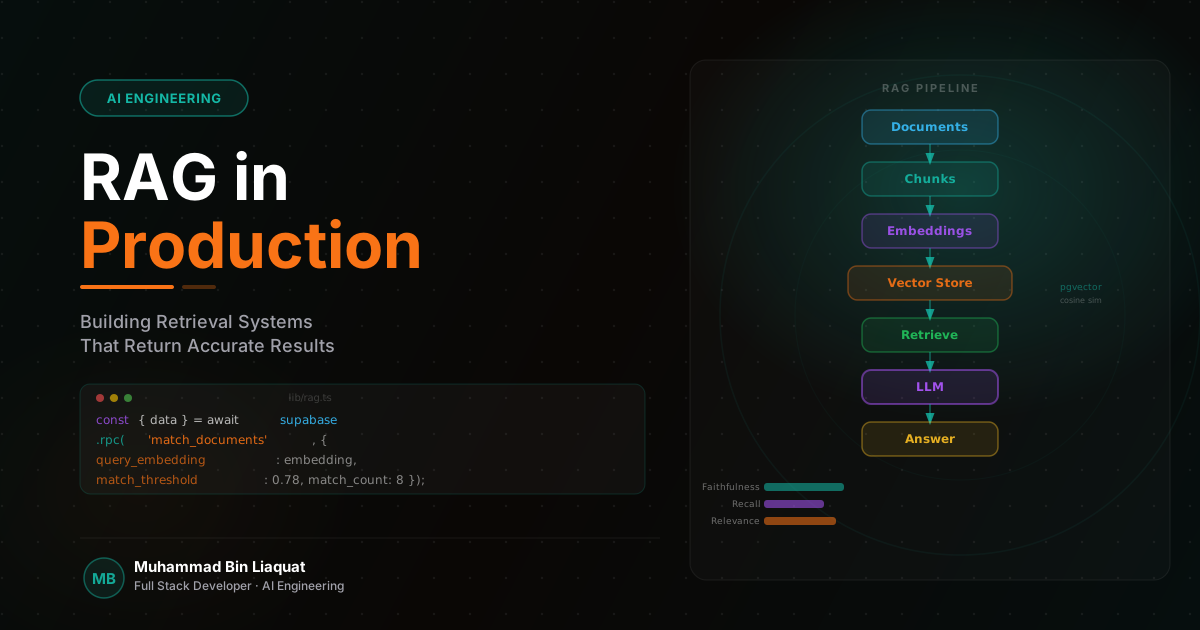
Long-term memory persists facts and user preferences across sessions. The standard architecture combines a relational database (for structured facts: user preferences, task completion state, subscription status) with a vector database (for semantic retrieval of past interactions, documents, and domain knowledge). When a new session starts, the agent retrieves relevant memories using semantic search over the vector store and injects them into the system prompt. Supabase with pgvector handles both relational storage and vector similarity search in a single database, which simplifies the infrastructure significantly.
For AI coaching platforms, legal tools, and any domain where the agent needs deep knowledge of a user's history, a hierarchical memory system produces the best results. Individual interactions are stored in raw form, summarized periodically into compressed representations, and the summaries are used for retrieval. This pyramid structure — raw interactions to session summaries to user profile to domain knowledge — allows the agent to be both specific about recent interactions and comprehensive about the user's history without exceeding context limits.
- Use conversation summarization to manage context window limits on long-running sessions.
- Store long-term user facts in a relational database; store semantic memory in a vector database (pgvector).
- Retrieve relevant memories at session start using semantic search — inject them as context into the system prompt.
- Summarize sessions periodically rather than storing full transcripts — compression preserves signal without noise.
- Separate episodic memory (what happened) from semantic memory (what was learned) — they serve different retrieval patterns.
Error recovery and graceful degradation in production agents
Agentic systems fail differently from deterministic software. A traditional application either completes a request successfully or throws an exception. An agent can partially complete a task, make incorrect assumptions mid-execution, call a tool with invalid parameters, get stuck in a reasoning loop, or conclude that a task is complete when it isn't. Each of these failure modes requires a different recovery strategy, and building that recovery in is the difference between a prototype and a production system.
Timeout handling is the most important defense against runaway agent execution. Set explicit time limits on the agent executor and on individual tool calls. When the agent exceeds the time limit, capture the current state (what has been done, what was attempted) and return a structured partial result rather than a generic timeout error. Users tolerate partial results better than complete failures, and partial results give you debugging context for understanding where the execution broke down.
Retry logic for tool failures should be configured with exponential backoff and a maximum retry count. For transient failures (network errors, rate limit responses), automatic retry with backoff is appropriate. For invalid input failures (the agent called a tool with incorrect parameters), retry without modification will produce the same failure — instead, return the error to the agent's reasoning loop so it can correct the parameters or choose a different approach. Distinguishing between these failure types in tool error responses is essential for intelligent retry behavior.
Human-in-the-loop (HITL) checkpoints are critical for agents with write permissions or the ability to take consequential actions. Implement explicit confirmation steps before any irreversible action — deleting records, sending emails, making purchases, or modifying external systems. Structure these checkpoints as agent tools: `request_human_approval(action_description, consequences)` returns either an approval or a rejection with an optional override instruction. This pattern keeps the agent in control of the flow while ensuring human oversight at critical decision points.
- Set explicit timeouts on both the agent executor and individual tool calls — never allow unbounded execution.
- Return structured partial results on timeout rather than generic failures — preserve execution context for debugging.
- Distinguish between transient and invalid-input failures in tool error responses — they require different retry strategies.
- Implement HITL checkpoints as agent tools for any irreversible action: approval must be received before execution.
- Log every agent execution with its full reasoning trace, tool calls, and final state — this data is essential for iteration.
Observability, tracing, and cost management for deployed agents
Agentic systems are expensive to operate and difficult to debug without purpose-built observability. A single user request can trigger dozens of LLM calls and tool invocations, each generating costs and latencies that aggregate in surprising ways. The standard approach of logging inputs and outputs at the API boundary is insufficient — you need visibility into the full reasoning chain, including intermediate thoughts, tool selections, and tool results, to understand why an agent behaved a specific way.
LangSmith (for LangChain), Langfuse, and Arize AI are the leading observability platforms for agentic systems. Each provides distributed tracing at the LLM call level, session-level visualizations of the agent's reasoning chain, and cost attribution per run. Integrating one of these platforms is straightforward in LangChain — it's typically a single environment variable configuration. The visibility they provide is indispensable for iterating on agent prompts and tool designs in production.
Cost management is a first-class concern in production agentic systems. Token costs for complex multi-step tasks can be significant — a poorly designed agent that takes 20 steps to complete a task that should take 5 will cost four times as much per request. Instrument every agent run with token usage metrics (prompt tokens, completion tokens, cost per run) and set per-run cost limits that trigger early termination with a graceful failure when exceeded. Analyze the cost distribution across users to identify outlier usage patterns that indicate agent inefficiency.
The quality evaluation loop is what separates production agentic systems from prototypes. Define task-specific success criteria for your agent — correct tool selection rate, task completion rate, hallucination rate, and average steps to completion — and measure these metrics systematically. Run your evaluation dataset against the agent after every significant change to the prompt or tool set. This evaluation discipline is what allows you to iterate on agent behavior with confidence that improvements in one dimension don't cause regressions in another.
- Integrate LangSmith or Langfuse from the start — observing the full reasoning chain is essential for iteration.
- Set per-run token cost limits that trigger graceful early termination when exceeded.
- Track completion rate, average steps, and cost per task as primary quality metrics.
- Run a fixed evaluation dataset after every prompt or tool change to detect regressions.
- Alert on p99 execution time and cost — outliers indicate agent loops or inefficient tool usage.
Share this article
Help others discover this resource and extend the reach of the content.