The problem with hourly billing for developers
Hourly billing is the default for freelance developers because it feels safe — you get paid for every hour you work, and the client assumes the risk of an uncertain timeline. But hourly billing has a structural problem: it penalizes expertise. As you get better at your craft and solve problems faster, you earn less for the same outcome. A developer who builds a feature in four hours earns less than one who takes eight, despite delivering the same (or better) result.
There's also a psychological problem. Hourly billing puts the client in a time-tracking mindset — scrutinizing hours, questioning whether an afternoon of research was 'really' billable, and pushing back on anything that looks like inefficiency. This dynamic is adversarial by design. Every hour you log is a potential objection. Fixed-price or value-based pricing removes this friction entirely and lets the conversation stay on outcomes rather than hours.
The shift away from hourly is not about eliminating risk for yourself — it's about aligning incentives correctly. When you quote a fixed price, you're incentivized to be efficient and deliver quality work on time. When you quote hourly, you're incentivized (however unconsciously) to be thorough in ways that extend the timeline. Clients who have worked with hourly developers before often have a visceral preference for fixed-price proposals because they know exactly what they're committing to.
- Calculate your effective hourly rate on fixed-price projects to track whether your pricing is accurate.
- If you must bill hourly, establish a weekly or monthly cap to reduce client anxiety about unlimited exposure.
- Use time-tracking on fixed-price projects privately — for estimation improvement, not client invoicing.
- Never bill hourly for revisions on creative work (design iterations, copy changes) — scope it upfront.
- Transition existing hourly clients to fixed-price retainers once trust is established.
Value-based pricing: anchor to outcomes, not effort
Value-based pricing means setting your price based on the economic value the project creates for the client, not the number of hours it takes to build. A new e-commerce site that generates £50,000 in its first year justifies a higher price than the same site built as a portfolio project for a startup with zero revenue — even if the technical work is identical. The price is anchored to the client's outcome, not your input.
To price on value, you need to understand the business impact of the project before you quote. Ask during discovery: what problem is this project solving, how much is that problem costing right now (in lost revenue, wasted time, or missed opportunities), and what does success look like in measurable terms? A redesigned SaaS onboarding flow that improves trial-to-paid conversion from 8% to 12% on 500 monthly trials is worth tens of thousands per year in additional revenue. Price accordingly.
The objection to value-based pricing is usually 'but my clients don't have big budgets.' This is sometimes true — small businesses, charities, and early-stage startups genuinely cannot pay premium rates. But more often, 'I can't afford that' is a negotiating position, not a financial reality. The way to test it: ask what budget they have allocated for this project. If they have a number, the conversation is about what you can deliver within it. If they have no number, they haven't thought seriously about the investment.
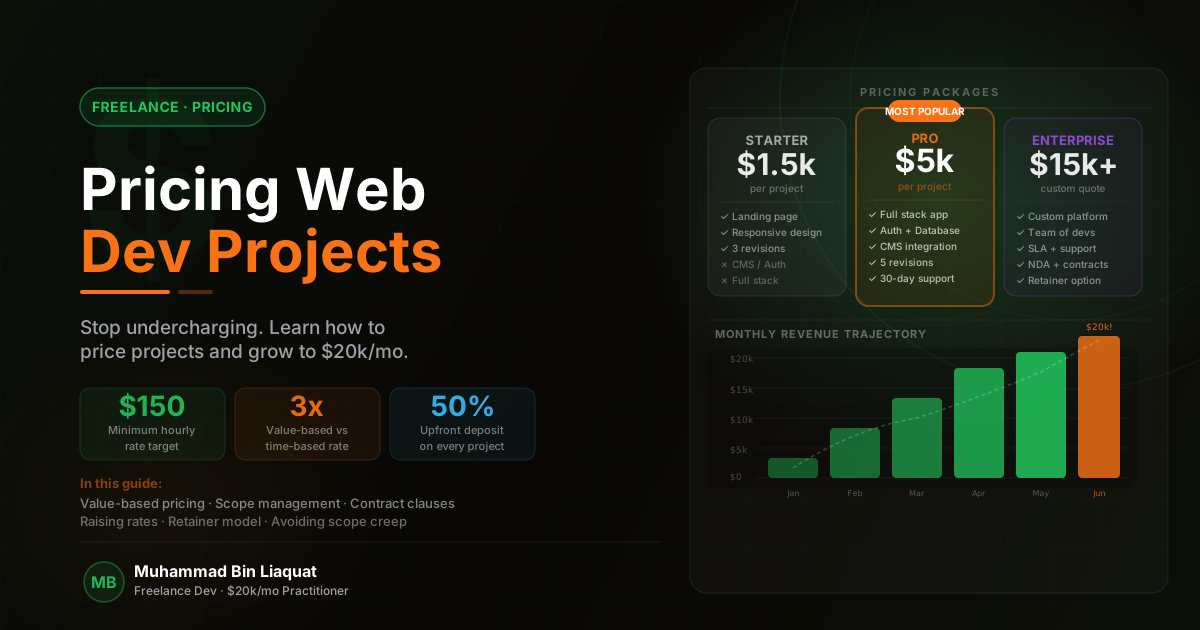
Anchor your prices high and offer to scope down, rather than anchoring low and trying to negotiate up. A proposal with three tiers — essential, standard, and comprehensive — gives clients a choice rather than a yes/no decision. The middle tier is usually what they buy, but the premium tier makes the standard look like good value. This packaging technique increases average deal size without any change in the underlying work.
- Ask 'what's the business impact of this project?' in every discovery call before building a proposal.
- Price a minimum of 10% of the project's projected first-year business value for a custom build.
- Offer three proposal tiers: Essential, Standard, and Comprehensive — most clients buy the middle.
- Never apologize for your price — present it confidently and let the silence land.
- If a client says the price is too high, ask what budget they have before offering a discount.
Structuring fixed-price proposals that protect your margins
A fixed-price proposal is only profitable when the scope is defined precisely enough that both parties agree on what 'done' means. Vague scope is the primary cause of freelance project losses — you quote based on your interpretation, the client has a different interpretation, and the difference comes out of your margin. The proposal document is the mechanism for eliminating this ambiguity before the contract is signed.
Structure your proposal with three sections: what's included, what's not included, and the assumptions. The inclusions section describes the deliverables precisely: 'a responsive five-page website including homepage, about, services, portfolio, and contact pages with a contact form that sends email notifications via SendGrid.' The exclusions section lists what is explicitly out of scope: 'copywriting, photography, stock image licensing, SEO content writing, third-party integrations beyond the contact form.' The assumptions section lists the conditions your quote depends on.
Revision rounds are the most common source of scope creep on design and development projects. Define them explicitly in the proposal: 'two rounds of feedback are included; additional rounds are billed at £X per round.' This is not punitive — it's a structure that helps clients consolidate their feedback and give it to you in usable batches. Projects without revision limits tend to accumulate feedback indefinitely.
Payment terms directly affect your cash flow risk on a project. Never start work without a deposit — 50% upfront on projects under £10,000 and 40-50% upfront on larger projects is standard. Structure milestone payments around deliverables, not calendar dates: 40% on project kickoff, 30% on design/architecture approval, 30% on final delivery. Never deliver the final project handoff without receiving final payment.
- Define a specific list of pages, features, and integrations — not vague deliverables like 'a website'.
- List exclusions explicitly: copywriting, stock photography, hosting setup, content migration.
- Limit revision rounds in the contract: two rounds included, additional at a defined day rate.
- Require 50% deposit before starting any work — this also filters out low-commitment clients.
- Never hand over final files, access, or deployments without receiving final payment.
Scope creep: recognizing it early and handling it professionally
Scope creep is the gradual expansion of project requirements beyond the agreed scope — usually through small, seemingly reasonable requests that individually seem minor but collectively represent significant additional work. The classic vector is 'while you're in there, could you also...'. Each individual request takes an hour; ten requests take a week; and none of them were in the original proposal.
The professional response to out-of-scope requests is not refusal — it's acknowledgment and pricing. 'That's a great idea, it's not in our current scope, but I can give you a quote for adding it. It would take approximately X hours and cost £Y — would you like to add it to the project, or shall we include it in a phase two?' This approach keeps the relationship positive, captures the additional revenue, and makes the scope boundary visible without being adversarial.
Pattern recognition is the key to catching scope creep before it's already happened. The warning signs: a client who schedules calls to 'discuss the project direction' halfway through development, requests for design changes after the design approval milestone, or a growing list of 'small things' that arrive in Slack rather than in a formal review. Each of these individually is manageable; the pattern indicates a client who has not finalized their vision.
Project change orders are the formal mechanism for scope changes. When an out-of-scope request is approved, issue a one-page change order: description of the additional work, estimated hours, cost, and impact on the delivery timeline. Both parties sign it before work begins. This paper trail protects you from payment disputes and makes the pattern of scope expansion visible to clients who may not realize how many small requests they've added.
- Respond to every out-of-scope request with 'I can quote that' rather than 'that's not in scope'.
- Issue a written change order for every approved scope addition, regardless of how small.
- Define 'design approval' as a formal milestone that freezes the design for development — put it in the contract.
- Log all project communication in a shared tool (Linear, Notion) rather than Slack — creates a paper trail.
- Watch for the pattern of small requests, not just the size of individual requests.
Raising your rates and building the positioning to support them
Most freelance developers raise their rates too infrequently, by too little, and with too much anxiety about losing clients. The reality: if you raise your rate by 20% and 20% of your clients leave, you're earning the same amount with less work. If 10% of clients leave, you're earning more with less work. Rate increases almost never produce the client exodus that developers fear.
Position yourself before raising your rate. Rate increases are most successful when they coincide with a positioning upgrade: a new case study that demonstrates a specific outcome, a published article that establishes authority in a niche, or a referral from a client in a new market segment. The rate is the price tag; the positioning is what justifies it. Raising a rate without changing positioning feels arbitrary to clients; raising it with new evidence of value feels like market reality.
Specialize as a lever for premium pricing. A developer who offers 'websites' competes with hundreds of other generalists. A developer who specializes in 'Next.js performance optimization for SaaS products' is competing in a much smaller market where premium rates are normal. Clients with specific, urgent problems will pay significantly more than clients looking for a generalist to execute their designs. Pick a niche that intersects your strongest skills with a client segment that has genuine budget.
Publish your rates — or at least your minimum engagement size — on your website. This sounds counterintuitive but is one of the most effective lead quality filters available. Stating 'projects typically start at £5,000' on your contact page eliminates all inquiries from clients who cannot meet that threshold, freeing up your time for conversations with clients who can.
- Raise rates with each new client engagement — not once a year as a blanket increase.
- Publish a minimum engagement size on your contact page to filter unqualified leads.
- Identify one specialization that commands a premium in your market and position around it.
- Add a new case study or publication before each rate increase to support the new positioning.
- Keep a record of every client's lifetime value — it will show you which client types to pursue and which to refer out.
Share this article
Help others discover this resource and extend the reach of the content.