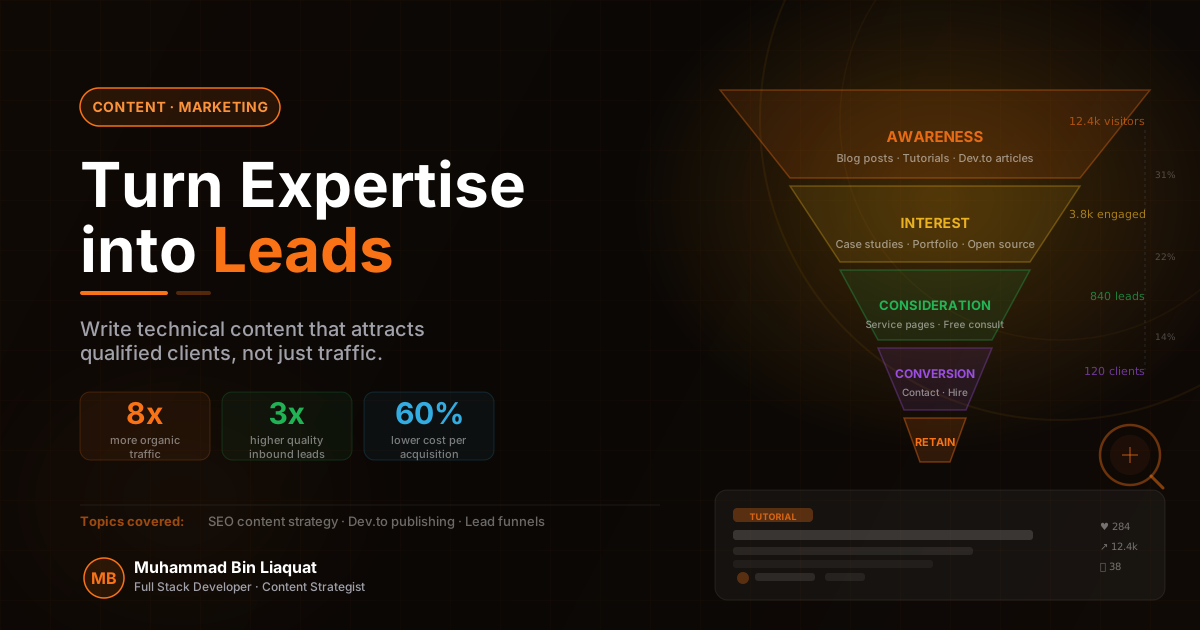
Why technical writing compounds when other efforts plateau
Most professional outreach — networking events, conference talks, LinkedIn posts — generates a short burst of visibility that decays immediately. A conversation at a conference is forgotten within a week. A LinkedIn post fades from feeds within 48 hours. Technical writing is structurally different: a well-structured article on a specific topic continues to surface in search results, be cited in other articles, and be shared in developer communities for months or years after it's published.
A well-ranked article is asymmetric leverage. You invest the time once, it ranks for queries your target audience searches, and it generates engagement continuously — without any ongoing effort. The article on a particular architectural pattern published in March is still answering questions in December. That compounding asymmetry is why technical writing is the highest-return investment available to engineers who want to build lasting visibility in their field.
Engineers who dismiss technical writing often cite two objections: 'the internet is full of tutorials already' and 'I don't have time.' Both are valid for the wrong kind of content. Generic tutorials covering what a technology is will never rank against established documentation sites. But specific, experience-driven articles — 'how we reduced p99 API latency from 800ms to 50ms' or 'the architectural tradeoff that cost us three weeks of refactoring' — compete in a completely different tier where specificity and depth win.
- Identify the technical problems you've solved that no existing article explains clearly — these are your highest-value topics.
- Write from specific implementation experience, not from documentation — the specificity is the differentiator.
- Plan for a 6-month horizon: content authority builds slowly then accelerates as content accumulates.
- Track article traffic and engagement from month one using Google Search Console.
- Treat each article as a permanent technical asset, not a one-time publishing event.
Choosing topics that demonstrate real expertise
The most important principle in technical topic selection is to write about the intersection of what you know deeply and what others are genuinely trying to understand. A tutorial that explains what something is covers territory that documentation already handles. An article that explains when to use it, why one approach is better in specific contexts, and what goes wrong in practice covers territory that only experienced practitioners can provide — and that's what earns authority.
Map topics to levels of technical depth. Surface-level content covers concepts and definitions — useful for beginners but competitive and low-authority. Intermediate content covers patterns and practices — how to structure a system, when to use one approach over another. Expert content covers tradeoffs, failures, and context-specific decisions — the kind of writing that only comes from having built, broken, and rebuilt real systems. The deeper the level, the less competition and the more credibility each piece establishes.
The fastest validation method for topic ideas is a combination of developer community search and keyword research tools. Search the topic in relevant forums and communities — if the same question appears repeatedly with unsatisfying answers, there's a gap worth filling. Check keyword difficulty in a tool like Ahrefs or Semrush: targeting keywords with a difficulty score below 20 is realistic when building a new content presence, while highly competitive terms require significant existing authority to rank for.
Counterintuitive or experience-based angles tend to outperform straightforward how-to content. 'Why we stopped using X after 6 months in production' generates more engagement and trust than 'How to get started with X.' 'The real cost of microservices at a 5-person team' surfaces tradeoffs that tutorial content ignores. These angles require genuine experience to write well, which is exactly why they differentiate.
- Target topics where you can speak from implementation experience, not just technical documentation.
- Use developer communities and Stack Overflow to find questions with no satisfying answer — those are article opportunities.
- Check keyword difficulty before investing in a topic: target under 20 KD when building authority from scratch.
- Write at least one 'we got this wrong and here's what we learned' article — these establish credibility faster than tutorials.
- Maintain an ideas list and log every technical problem you encounter that lacks good written coverage.
The writing process that produces articles worth reading
The biggest quality gap in technical writing is between authors who document what something is and authors who explain what to do about it and why. Documentation-style writing is widely available. Experience-driven prescriptive writing — with actual code, specific tradeoffs, and honest assessment of failure modes — is what earns bookmarks, citations, and long-term traffic. The difference is usually not talent but intention: are you writing to inform or to teach?
Before writing, answer three questions: who exactly is this for, what decision or action will they take after reading it, and what makes this article better than the top results currently ranking for this keyword? The answer to the third question is the differentiation angle. Usually it's specificity — more detailed, more concrete, with actual code rather than pseudocode. Sometimes it's recency — existing articles are two years old and the ecosystem has changed. Sometimes it's framing — existing articles explain how but not when or why.
Structure each article to front-load value. The introduction should communicate the outcome and deliver the first piece of useful information within the first two paragraphs. Readers scan before they commit to reading — the heading hierarchy and the first sentence of each section should tell the full story independently. This is not pandering to short attention spans; it's respecting that readers are evaluating whether the article deserves their full attention.
Working code examples are the single most effective differentiator in technical content. Real, runnable code — not pseudocode, not simplified abstractions, but the actual pattern you would use in production — separates genuinely useful articles from polished overviews. Pair each code example with an explanation of not just what it does but why you would choose it over the alternatives. The 'why' is what cannot be found in documentation.
- Write the introduction last — after you know exactly what the article delivers, you can promise it accurately.
- Include at least one real, runnable code example per major section.
- Use subheadings that convey a complete idea: 'useCallback prevents stale closures' not 'callbacks'.
- Add a 'when to use this' and 'when not to use this' section for any technique you recommend.
- Edit for word count by removing adverbs, hedges, and repeated explanations — not by shortening examples.
Building an audience from technical content
Publishing without a distribution strategy is like shipping software without telling anyone it exists. Every article needs an active distribution plan for the first 48 hours and a passive discovery mechanism for the long term. The short-term effort — sharing in relevant communities, posting on LinkedIn and X — generates immediate traffic and backlinks. The long-term mechanism — SEO optimization, internal linking, and consistent publishing — is what drives compounding growth.
Developer communities are the highest-signal distribution channels for technical content. Relevant subreddits, Discord servers, Slack groups, and Hacker News are where technical readers discover new content before it ranks in search. The key to effective community sharing is context: explain why the article is relevant to that community specifically, what specific question it answers, and what makes it worth reading over other content on the topic. Generic 'I wrote this' posts generate minimal engagement.
An email list is worth building once a content library exists. Readers who find your content valuable enough to subscribe represent a significantly more engaged audience than search traffic alone. A content upgrade — a downloadable reference, a companion code repository, or a companion checklist — converts readers at higher rates than a generic newsletter signup. Even a small, highly engaged email list amplifies every new article you publish.
Track the downstream impact of each article. Which articles generate the most return visits? Which generate the most discussion in communities? Which rank for the most keywords? Over time, patterns emerge that identify which topic areas and formats generate the most durable engagement. Invest subsequent content in the topical neighborhood of your highest-performing pieces, building cluster density where you already have traction.
- Share each article in 2-3 relevant developer communities within 24 hours of publishing.
- Write a community post that explains the specific problem the article solves — not just a link.
- Create one downloadable resource (checklist, code repo, reference card) for your highest-traffic article.
- Track which articles generate return visits and backlinks — these are the topics to expand.
- Internal link from every new article to related existing content to reinforce topical clusters.
The publishing system that sustains output
Consistency of output matters more than individual article quality, especially in the early months of building a content presence. One genuine, thorough article per month published reliably builds more authority over twelve months than six outstanding articles published sporadically. Search engines reward consistent publishing signals — each new article creates additional indexed pages, earns internal links from previous content, and strengthens topical authority that lifts older articles.
Build a content calendar that maps articles to topic clusters. Each cluster has a pillar article — the comprehensive overview — and several supporting articles covering specific techniques, comparisons, and case studies. Publish supporting articles first to populate the cluster, then publish the pillar article that links to all of them. This sequencing ensures the pillar has content to reference when it goes live, which accelerates its crawling and initial ranking.
Refreshing older articles is often more effective than publishing new ones once a content library exists. Find articles ranking on page two or three for their target keyword and update them: add a new section, update outdated code examples, improve the introduction, and update the dateModified schema. Google frequently re-evaluates content after an update signal and promotes refreshed articles that demonstrate genuine quality improvement.
Repurpose content across platforms without diluting the original. A long-form article becomes a concise LinkedIn post summarizing the key insight, with a link to the full piece. Code examples become standalone GitHub Gists that link back for context. Key concepts become X threads that reach developers who don't search Google for technical content. Each repurpose reaches a different audience while driving traffic back to the canonical article.
- Maintain a 12-month content calendar with topic clusters mapped — dates and topics, not just ideas.
- Publish supporting articles before the pillar article so the pillar has content to link to.
- Schedule quarterly reviews of all articles — identify page 2-3 rankers for refresh priority.
- Repurpose every article as a LinkedIn post within 48 hours of publishing.
- Set Google Search Console alerts for articles that drop in ranking — these are the highest-priority refresh candidates.
Measuring impact and iterating on content strategy
Content strategy without measurement is speculation. Google Search Console, GA4, and a simple content tracking spreadsheet give you everything needed to make data-informed decisions about what to write next, what to refresh, and where to focus distribution effort. The three metrics that matter most: organic impressions (how often your content appears in search), click-through rate (how compelling your titles and descriptions are), and average position (where you rank for target keywords).
Set up Google Search Console on day one and review it weekly. The Performance report shows which queries bring traffic to each article, what position you rank, and how click-through rate compares between pages. Articles with high impressions but low click-through rate have a title or description problem — the search result is not compelling even when it appears. Articles with high position but low traffic are targeting low-volume keywords — worth updating to target adjacent, higher-volume terms.
Content velocity compounds. An article published six months ago has had time to accumulate backlinks, be indexed thoroughly, and establish topical authority. Its presence makes every new article in the same cluster easier to rank because the cluster's authority is established. This is why the return on technical writing accelerates over time — the first few articles are difficult, but the tenth article in a topic cluster benefits from the authority established by the previous nine.
Evaluate your content strategy quarterly against your goals. If the goal is visibility in a specific technical domain, are articles in that domain accumulating rankings? If the goal is demonstrating expertise in a particular technology stack, does the content library reflect that depth? Adjust topic selection, update older content, and double down on the clusters where traction already exists rather than spreading effort across unrelated topics.
- Check Google Search Console weekly — impressions, click-through rate, and average position by page.
- Identify articles with high impressions but low click-through rate first — improving the title is a fast win.
- Track the average position trend for your highest-priority articles month over month.
- Review the content strategy quarterly against your authority goals and adjust topic clusters.
- Celebrate article milestones (first 1,000 impressions, page 1 ranking) to sustain publishing momentum.
Share this article
Help others discover this resource and extend the reach of the content.